
 +86 15340683922
 +86 15340683922
الوصف
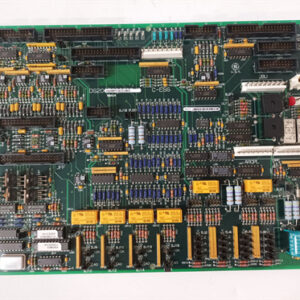
The GE DS200TCRAG1 is a foundational version of a Relay Output Card designed for the GE Mark V Speedtronic Turbine Control System.
This board, identified by the functional acronym TCRA, is dedicated to providing hard-wired, high-current switching outputs that the turbine control system uses to interface with field devices like solenoids, contactors, and trip mechanisms.
💡 Function of the DS200TCRAG1
The $\text{DS200TCRAG1}$ board’s primary role is to convert low-power digital control signals generated by the Mark V processor into high-power discrete signals capable of operating external field equipment.
1. Discrete Control Outputs
- Actuator Control: It drives the coils of heavy-duty relays, which in turn switch the voltage to crucial turbine components.
- Valve Operation: In turbine applications, the outputs are used to operate solenoid valves, such as those controlling hydraulic fluid for fuel control, steam admission, or trip/shutdown systems.
- Example Application: In some cores ($\text{Q11}$ core), the board’s four relays are sometimes dedicated to operating gas manifold blow-off valves. In other cores ($\text{Q51}$ core), the relays are often configured to provide power for multiple solenoid outputs.
2. Hardware Features
The $\text{TCRA}$ board is designed for robustness and ease of maintenance:
- Relays: The $\text{TCRA}$ boards (including the $\text{G1}$ and later $\text{G1A}$ revisions) typically house up to 30 plug-in relays. The “plug-in” feature is crucial as it allows for quick and easy replacement of individual relays in the event of a failure, simplifying maintenance.
- Connectors: It uses multi-pin connectors ($\text{34-pin}$ and $\text{12-pin}$) to connect to the digital I/O processor boards ($\text{DTB}$) and the external terminal blocks where field wiring is terminated.
- Configuration: The board itself is primarily a relay interface. The specific configuration and function of each relay are typically set by hardware jumpers on the related $\text{DTBC}$ and $\text{DTBD}$ terminal boards connected to it.
🔄 Revision Status
The part number DS200TCRAG1 represents the initial production version of this board. Subsequent revisions, such as the $\text{G1A}$ and $\text{G2A}$, are functionally similar but incorporate minor design changes, component updates, or artwork modifications.
In the Mark V system, the reliable operation of the $\text{DS200TCRAG1}$ is critical for executing the final control actions required for safe and effective turbine operation.