
 +86 15340683922
 +86 15340683922
الوصف
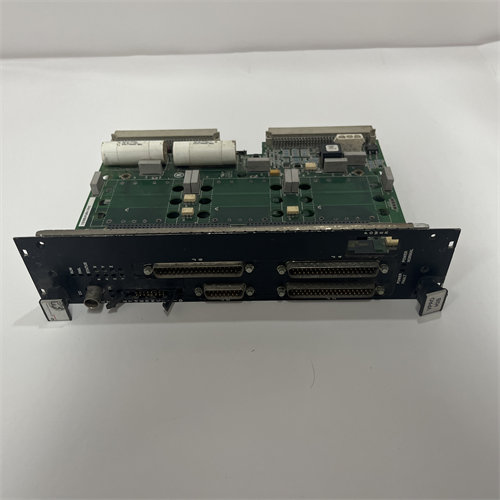
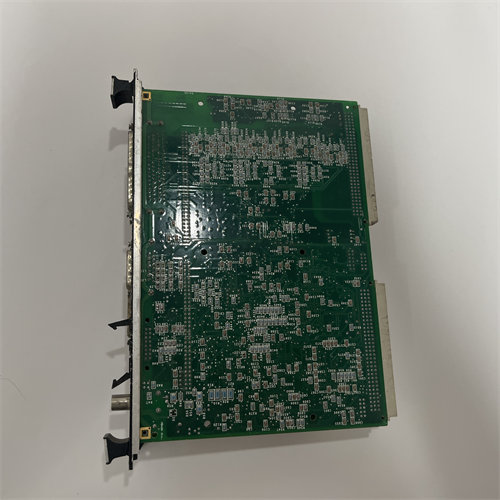
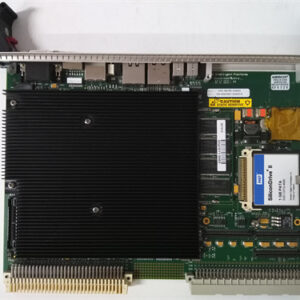
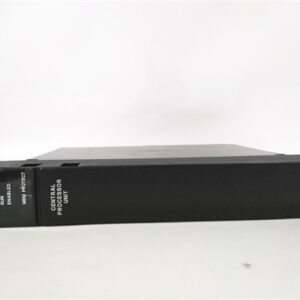
The GE DS200UCPBG6AFB is an I/O Engine CPU Board (UCPB) manufactured by General Electric for use in the Speedtronic Mark V Turbine Control System (DS200 Series).1
This board serves as the dedicated processor for an Input/Output (2$\text{I/O}$) engine, managing the communication and processing of field data for the main turbine controllers.3
💻 Key Function and Role
The primary function of the $\text{DS200UCPBG6AFB}$ is to process, package, and transmit I/O data to the main Triple Modular Redundant ($\text{TMR}$) controllers ($\text{R, S, T}$) via the $\text{COREBUS}$ communication link.
- I/O Processing: It contains a microprocessor that handles the raw signals received from the I/O termination boards and converts them into digital data packets.4 This dedicates processing power to the I/O function, keeping the main $\text{TMR}$ controllers focused on critical control and protection algorithms.
- Communication Bridge: It utilizes an ARCNET driver to broadcast data packets over the 5$\text{COREBUS}$ to the 6$\text{R, S, and T}$ control cores.7 This communication is essential for the $\text{TMR}$ system to perform its two-out-of-three voting on sensor inputs.
- Physical Location: The UCPB board is typically installed as a daughterboard mounted on the 8$\text{STCA}$ (I/O Engine 9$\text{ST}$ Card Assembly) within the I/O cores (e.g., 10$\text{R1}$, 11$\text{R2}$, 12$\text{R3}$).13
- Data Handling: It is responsible for organizing the data into “fast packets” (for critical, time-sensitive information, typically at 14$100 \text{ Hz}$) and “slow packets” (for less critical data).15
📋 Technical Specifications
| Feature | Detail |
| System | GE Speedtronic Mark V Turbine Control System |
| Part Type | I/O Engine Central Processing Unit Board ($\text{UCPB}$) |
| Processor | 80486DX microprocessor (CPU) |
| Communication | ARCNET driver for $\text{COREBUS}$ link |
| Memory | Uses PROM modules (for firmware/programming) and a $\text{DIMM}$ or $\text{SIMM}$ connector (for $\text{DRAM}$) |
| Configuration | Features DIP switches to set the $\text{COREBUS}$ address for the $\text{I/O Engine}$ and various hardware jumpers for settings like $\text{CPU}$ speed. |
| Connections | Includes $\text{COM1}$ and $\text{COM2}$ ($\text{RS-232}$ serial ports) and connectors for the $\text{COREBUS}$ and other internal busses ($\text{J1}$, $\text{J2}$). |
Note: Since the 16$\text{Mark V}$ is a legacy system, the 17$\text{DS200UCPBG6AFB}$ is generally considered an obsolete part, but it remains a critical component in many operating turbine control systems.18