
 +86 15340683922
 +86 15340683922
الوصف
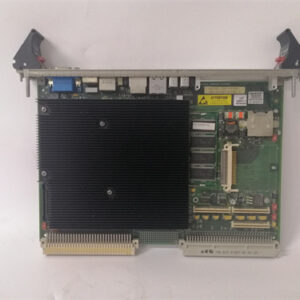
The GE DS200UCPBG6AFB I/O Engine CPU Board is a crucial processing module manufactured by General Electric (GE) for their Mark V Speedtronic Turbine Control Systems (specifically, the 1$\text{DS200}$ series).2
It functions as the Central Processing Unit (CPU) for an Input/Output (I/O) Engine, managing the complex data exchange between the turbine’s sensors/actuators and the main control system cores.3
🧠 Key Features and Function
This board is typically a daughterboard that mounts onto a main board (like the 4$\text{STCA}$ board) within one of the I/O Engine sections (e.g., R1, R2, R3, R5).5
- Primary Role: To process and manage the flow of analog and digital data coming from the various 6$\text{I/O}$ modules in its engine.7 It transforms raw sensor signals into usable data packets.8
- Processor: It contains an embedded 486DX microprocessor (or similar older industrial CPU) to execute the firmware and process the $\text{I/O}$ data.
- Data Communication: It is responsible for packaging the 9$\text{I/O}$ information and broadcasting it to the main triple-redundant control cores (R, S, T) over the COREBUS network via an ARCNET driver.10
- Fast Packets: Transmits critical data at a high rate (e.g., 100 Hz or every 11$10\text{ ms}$).12
- Slow Packets: Transmits less critical data at a slower rate.
- Memory and Firmware: It includes sockets for PROM (Programmable Read-Only Memory) modules which store the system’s firmware and programming instructions.13 When replacing the board, these PROMs must be transferred from the old board to the new one to maintain the correct operational programming.14
- Configuration: It contains hardware components like DIP switches for setting the unique COREBUS address for the specific 15$\text{I/O}$ Engine it serves.16
⚙️ System Context (Mark V)
In the Mark V architecture, the turbine control is performed by three redundant cores. The I/O Engine CPU Board provides the interface between these core controllers and the physical equipment.17
- The board receives configuration data and commands from the main control cores.
- It uses its processor and firmware to collect real-time data from local I/O modules (e.g., thermocouple boards, digital input/output boards).
- It communicates this processed data back to the main control cores, enabling the TMR (Triple Modular Redundancy) system to make control decisions based on reliable, timely information.18
Due to the critical nature of its function, its design emphasizes durability and reliability for operation in industrial environments.19