
 +86 15340683922
 +86 15340683922
الوصف
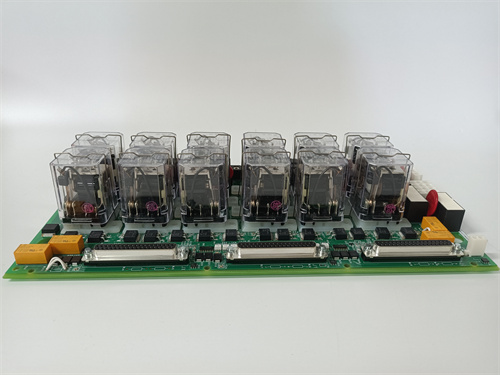
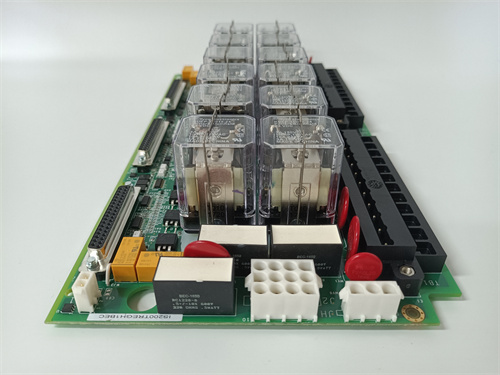
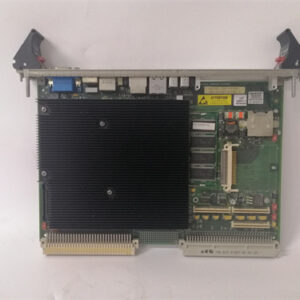
The GE IS200EGPAG1ABD Exciter Gate Pulse Amplifier Board (EGPA) is a crucial printed circuit board used in the GE EX2100 Excitation Control System.1
Its primary role is to act as the interface between the low-voltage control electronics and the high-power SCR (Thyristor) bridge to ensure precise and safe control of the generator’s field current.2
⚡ Core Functions of the EGPA
The EGPA board is located in the Power Conversion Cabinet (PCC) and performs a dual function: signal control and bridge monitoring.3
1. Gate Pulse Firing Control
- Amplification: The EGPA receives low-level firing commands (gate pulses) from the ESEL (Exciter Selector) board in the control module.4
- Gating: It amplifies and conditions these commands to generate the powerful, isolated gate pulses necessary to safely fire (turn on) the up to six Silicon Controlled Rectifiers (SCRs) in the three-phase exciter bridge.5 This precise firing is what controls the amount of DC current flowing to the generator field.
- Power: The gate firing power is typically supplied by a dedicated 6$125\text{ V DC}$ source (via connector J8) to ensure reliable operation regardless of control system variations.7
2. Bridge Protection and Monitoring
The EGPA serves as the main interface for critical diagnostics and protection mechanisms in the power bridge:8
- Temperature Monitoring: It interfaces with RTD (thermistor) sensors or thermal switches mounted on the SCR heatsinks to monitor bridge temperature.9 It sends alarm and trip signals to the controller if temperature limits (e.g., 10$170^\circ\text{F}$ for alarm, 11$190^\circ\text{F}$ for trip) are exceeded.12
- Airflow/Fan Monitoring: It monitors up to four cooling fans in the bridge, accepting pulsed or dry-contact sensor inputs to detect a loss of airflow—a critical fault condition.13
- Conduction Current Feedback: It provides power to and receives signals from Hall Effect sensors (often via companion EXCS boards) that monitor the current conduction status on all three phases of the bridge.14 This feedback confirms that the SCRs are firing correctly.
- Line Filter Fuse Sensing: It accepts an input to monitor the integrity of the line filter fuse on the bridge.15
🛠️ Technical Details
| Feature | Details |
| System | GE EX2100 Excitation Control System |
| Location | Power Conversion Cabinet (PCC) |
| Associated SCRs | Controls up to six SCRs (for a three-phase bridge) |
| Control Input | Receives commands from the ESEL board |
| Power Supply | Nominal $125\text{ V DC}$ (range $80-140\text{ V DC}$) |
| Monitoring I/O | Bridge Temperature, Fan Airflow, Conduction Status, Fuse Status |
| Revision | The suffix G1ABD denotes the specific hardware and artwork revisions. |
The EGPA is therefore indispensable for the reliable, safe, and regulated operation of the generator’s excitation system.